



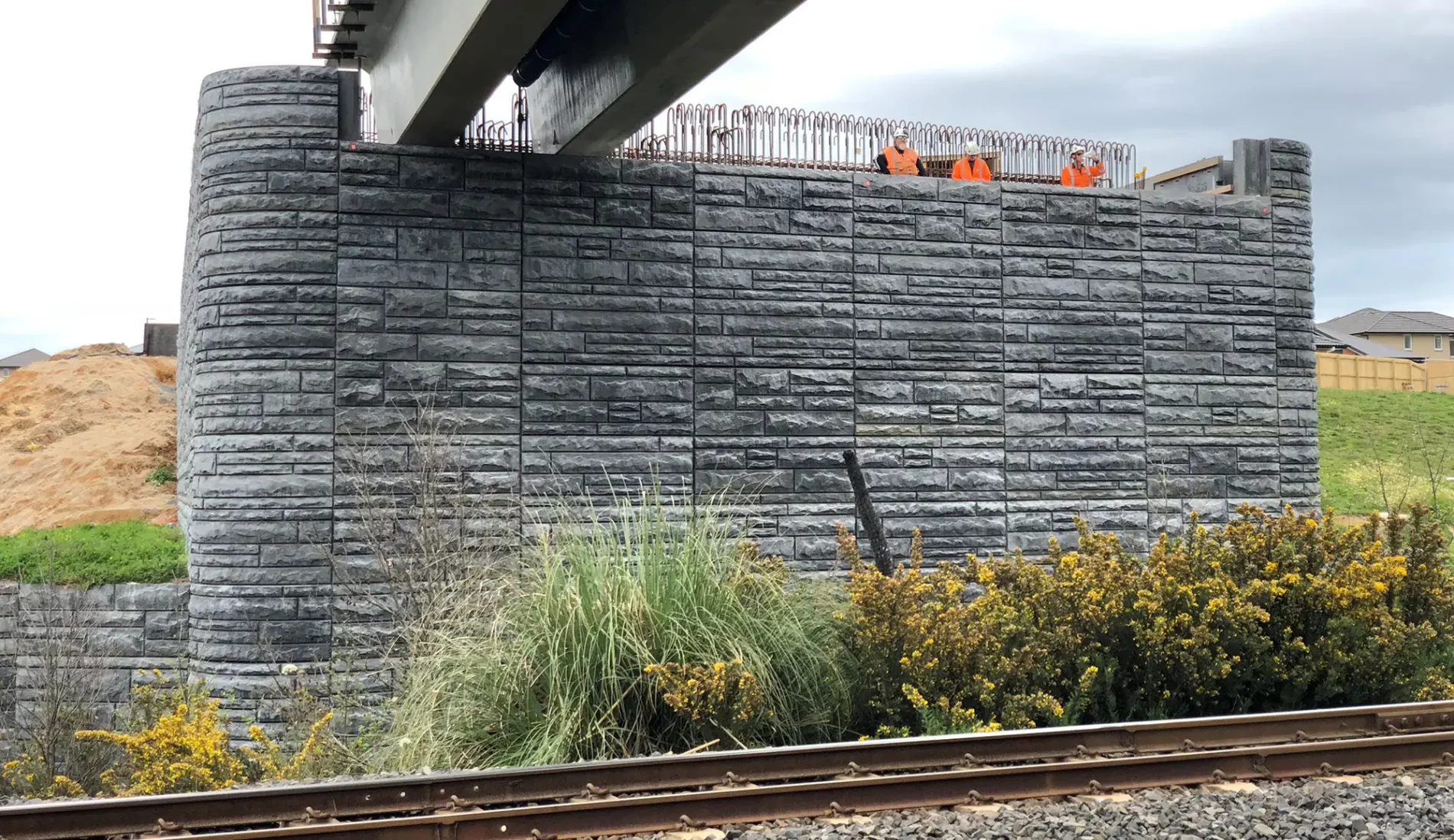

Whether the goal is stabilizing a steep slope, protecting a shoreline, or creating an unconventional public feature, Stone Strong Systems has built a reputation for producing retaining wall solutions capable of meeting a wide range of engineering challenges. Over more than two decades, the company has developed a precast concrete system that combines scale, adaptability, and durability, allowing designers and contractors to approach complex site conditions with greater confidence.
Stone Strong began in 2001 under the leadership of current president John Gran. With experience in both construction and retaining wall systems, John developed a deep understanding of day-to-day operations across the supply chain. By observing how retaining wall blocks were loaded, shipped, and installed, he recognized a gap in the market. Those observations led to a simple but transformative question about industry practices: while the trend had always been toward smaller blocks, why not go bigger?
That concept would ultimately shape the foundation of the Stone Strong system. Larger precast blocks offered advantages in handling, installation efficiency, and structural performance, particularly for applications requiring significant height or load-bearing capacity. By shifting the focus toward larger-format precast units, the company was able to create retaining wall systems capable of addressing a broader range of infrastructure and site development needs.
From its earliest designs, Stone Strong has been shaped by a commitment to continuous improvement—driven by real-world feedback from engineers, contractors, and project owners. As Nathan Gran puts it, the system has evolved through an ongoing dialogue with the field: “It started with one big block. Then came the real-world demands—corners, radiuses, and the big question: how high can we build?” That mindset still defines Stone Strong today. The focus remains on refining the system, pushing performance limits, and integrating new technologies—always working to make it better, stronger, and more capable with every iteration.
“It started with one big block. Then came the real-world demands—corners, radiuses, and the big question: how high can we build?”
This commitment to iteration has steadily expanded both the company’s product catalogue and its geographic reach. From a single production location in 2001, Stone Strong now celebrates its 25th year with locations across the United States, Canada, and New Zealand. The system’s versatility has contributed significantly to that growth. Stone Strong walls are now used across a wide spectrum of applications, ranging from transportation infrastructure, shoreline stabilization, commercial, and residential development. Typical uses include bridge abutments, channels, roadways, culverts, and water retention structures, as well as landscape and architectural installations in both public and private projects. Although most wall installations occur within commercial or civil infrastructure environments, the system’s design also encourages creative architectural uses. “Several amphitheaters have been constructed, where the blocks have been used for seating,” Gran said. In those cases, the retaining walls become not just structural components but functional elements of public space.
To support aesthetic considerations, Stone Strong offers a range of color and surface finish options, allowing engineers and architects to integrate retaining structures into broader design schemes while maintaining structural performance.
Some of the most technically demanding applications have occurred in regions with challenging environmental conditions. In Texas, for example, rapid fluctuations in water levels require infrastructure capable of handling significant hydrostatic pressure and changing hydraulic conditions. Stone Strong’s hollow-core block design has proven effective in these circumstances. Stone Strong’s channel systems, Gran explained, “function quite well” in these environments. “It has a hollow design, so it can handle very rapid rise and drawdown in water levels,” he said.
The company creates reliable precast solutions for complex and challenging site conditions that meet the needs of architects, engineers, and developers. Demonstrating the performance and constructability of the system is therefore central to Stone Strong’s outreach strategy. The company regularly hosts technical webinars and educational sessions for engineering professionals interested in understanding how the retaining wall system performs under different design scenarios. Over the years, the technology has been installed on a number of notable projects across North America, illustrating its adaptability across different sectors and environmental conditions.
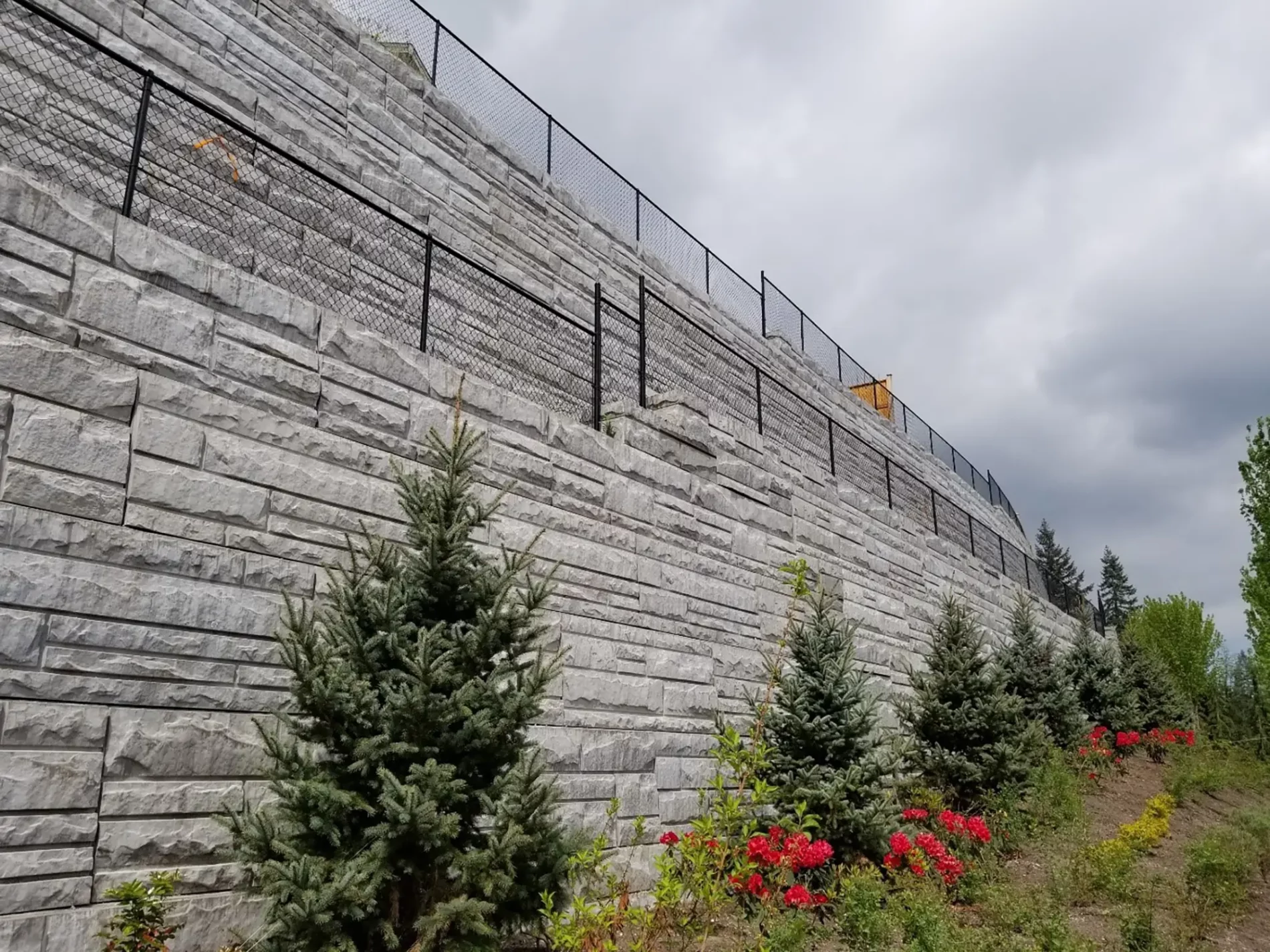
One example is among the tallest freestanding precast retaining wall installations in New England. The 17,000-square-foot project, managed by Onyx Corp. of Acton, Massachusetts, utilized 850 precast concrete blocks manufactured by MBO Precast Inc. The retaining structure incorporated ten different block types and was designed not only for structural integrity but also for visual integration with its surroundings. Together, the components created the appearance of a granite façade with hand-chiseled detailing.
The L-shaped wall includes a 334-foot section along the west side and a 362-foot section to the north. Through the use of overlapping rebar and engineered structural design, the system achieved heights of 51 feet—three feet higher than the original design requirement—providing additional safety margins while maintaining stability.
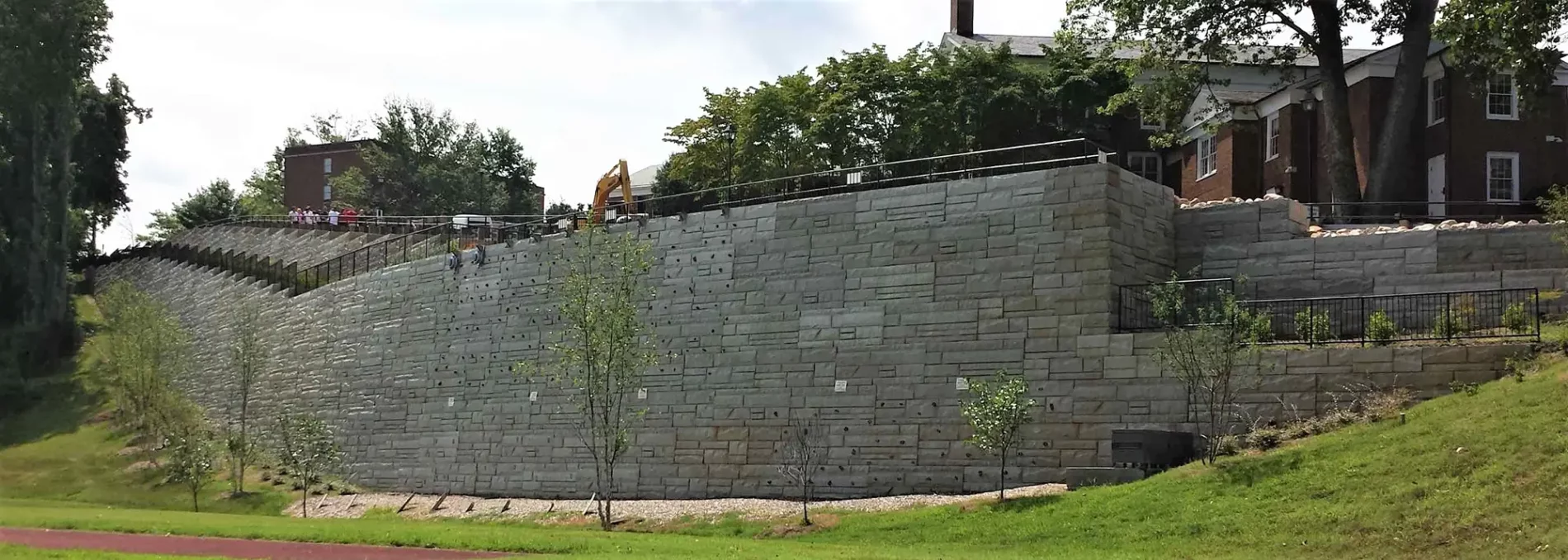
Another project demonstrating the system’s adaptability took place at Lynchburg College, where campus expansion created a need for a new access road capable of accommodating construction vehicles delivering materials to a $12 million student center renovation. Because the site terrain was steep, the roadway required a retaining wall approximately 20 feet high. Rather than treating the wall purely as a structural necessity, the college saw an opportunity to create a community feature. The retaining wall was designed to double as a climbing wall for student activities. This concept was realized through collaboration with Concrete Pipe and Precast, LLC and Eagle Site Solutions. The final design incorporated three separate wall structures spanning a total of 12,500 square feet. Two were gravity walls, while the third incorporated steel-reinforced geogrid construction. The installation was completed in just four months, allowing climbing fixtures and safety equipment to be installed on the tallest section of the wall, which rises to 24 feet. The project illustrates how structural infrastructure can be integrated with recreational design when engineers and contractors are willing to explore unconventional uses of building systems.
Stone Strong’s retaining wall technology has also been deployed on major logistics infrastructure projects. One notable example is the 2.8-million-square-foot Amazon fulfillment center constructed in Ottawa, Canada. Managed by Broccolini Construction, the facility is the largest fulfillment center in the country. The site presented a particular challenge due to its location near the exit ramp of Highway 416. A retaining structure was required to prevent water erosion affecting the parking areas, but the limited footprint between the property boundary and the adjacent roadway meant that traditional tieback systems were not feasible. Stone Strong addressed the challenge with a strict gravity wall design that fit within the available footprint. The wall ultimately reached a height of 29 feet and was installed by local contractor R.W. Tomlinson.
M CON Products manufactured 1,779 precast blocks along with 325 precast mass extenders to accelerate installation. Despite the region’s severe winter conditions, Tomlinson completed the work in just four months, demonstrating the system’s suitability for projects where schedule and weather constraints intersect.
Beyond individual projects, Stone Strong continues to expand its network of licensed producers. Innovation remains central to the company’s strategy. Stone Strong introduced a redesigned corner block that allows multiple configurations using a single mold form. This flexibility reduces manufacturing complexity while expanding design possibilities for engineers and contractors.
Gran emphasizes that the company’s development process remains closely tied to the needs expressed by its users. “What we’ve done over the past 20 years is simple—we’ve listened,” he said. “Every new product comes from that, whether it’s driven by innovation or a real need in the field.” By continuously evaluating both market demands and product performance, the company seeks to refine existing solutions while identifying new opportunities for improvement. As Gran put it, the process is ongoing: “We’re always looking at the market, and always looking at what we’re doing to see what we can improve on, whether that’s what we already have as a product, or if we need something new.”
Through that approach, Stone Strong has positioned itself as a specialized provider within the precast retaining wall sector—built not only on structural capability, but on a sustained commitment to listening, adapting, and engineering solutions that evolve with the needs of the industry—because at its core, the mission remains simple: Think Big. Build Bigger.