





In construction, reputation is rarely built through scale alone. More often, it is earned through consistency, follow-through, and the ability to deliver exactly what was promised. For Delventhal, a self-performing general contracting and construction management firm based in northwest Ohio, that principle has guided the company since its founding.
Delventhal was established in March 2002 by Steve Delventhal, an industry veteran with a clear objective: to build a company grounded in relationships focused on efficiency, accountability, and skilled self-performed work. The firm’s first office was located on Madison Avenue in downtown Toledo. As demand grew and opportunities expanded, Delventhal relocated in 2005 to its current headquarters in Millbury, Ohio, a move that reflected both business growth and long-term commitment to the region.
From the outset, Delventhal positioned itself as a lean operation, focused on execution rather than excess. “We are a skilled-trades general contractor, and we are very efficient, so we don’t have a lot of overhead, or a whole lot of moving parts, so we can be competitive – and we can be efficient,” said Rob Monak, Delventhal’s business development manager. That efficiency, he explained, is not accidental. It is supported by deliberate investment in field talent, safety, and planning. “Along with our leadership team and our in-house staff, what really is important is the talent out in the field has the proper training, the proper safety, the proper tools, and the proper schedule adherence. You don’t have to be the biggest. You just have to be the best at what you do.”
“Along with our leadership team and our in-house staff, what really is important is the talent out in the field has the proper training, the proper safety, the proper tools, and the proper schedule adherence. You don’t have to be the biggest. You just have to be the best at what you do.”
That mindset is reinforced by a clear set of values that Delventhal applies to every project. “When people say, well, why us? Why Delventhal?” Monak continued. “Our pillars are Dependable, Flexible, and Credible. Anybody could say that, but you’ve really got to have the proof in the pudding to deliver on that.”
The company’s early performance provided that proof quickly. In its first year of operations, Delventhal generated approximately $7 million in revenue. Within a few years, that figure grew to between $18 million and $20 million annually, supported by what the company describes as a strong portfolio of repeat clients across multiple sectors. “Our first year in business, we realized approximately $7 million in revenue and, a few years later, grew to $18 million to $20 million with a respectable portfolio of repeat clients across different industries,” said office manager Cathy Permar.
That repeat business, she noted, was central to establishing Delventhal’s position in the regional market. Client confidence in the firm’s technical ability and service approach was instrumental in “establishing The Delventhal Company as a serious competitor in the greater Toledo and northwest Ohio marketplace.”
As the business matured, ownership transitioned in a way designed to support further expansion. In 2015, Jess Jr., acquired the company, bringing with him a focus on strategic growth and broader geographic reach. “With a focus on growing the company and expanding licensing and services across the country for select clients,” Permar explained, the new ownership laid the groundwork for national expansion.
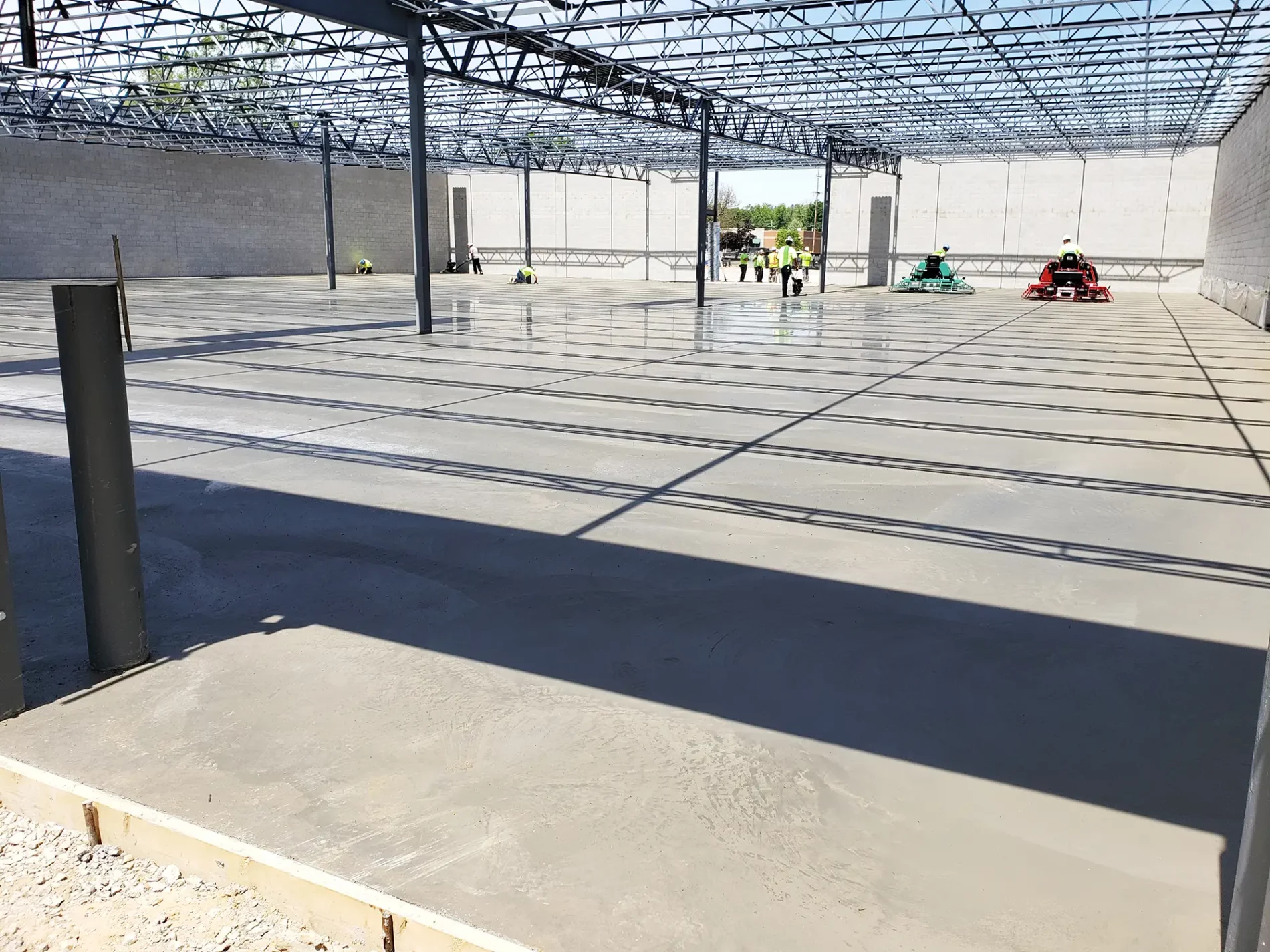
The firm’s trajectory remains steady. Today, Delventhal operates as a self-performing general contractor, offering both design-build and construction management services. The company, however, provides a range of other services with a particular strength in concrete construction. Its project portfolio spans a wide range of delivery methods and building types, including commercial and retail facilities, financial institutions, government and park facilities, educational projects, industrial work, and pre-engineered metal buildings.
Approximately 30 percent of Delventhal’s work is secured through public, competitive bids. Company leadership attributes its success in that arena to an ability to deliver quality construction while maintaining schedule and budget discipline—an especially critical requirement when working with public funds. “This requires close collaboration with our public clients to find solutions that are cost-effective and time-saving,” Permar said.
At the same time, Delventhal sees private-sector work as an opportunity to fully exercise its strengths as a construction partner. “Work in the private sector provides the greatest opportunities for fulfilling our niche of helping clients from vision, through completion of their projects,” Permar explained. “As the client’s construction partner, we offer a personal, collaborative approach to exploring all of the possibilities that leverage our industry experience, to provide value engineering and customized solutions based on their unique needs.”
That collaborative approach extends beyond Delventhal’s internal team. Clients also benefit from the firm’s established network of architects, designers, engineers, subcontractors, and suppliers, as well as its experience delivering both interior and exterior renovation projects. Paired with a strong safety culture and skilled workforce, the company positions itself as a reliable partner capable of delivering complex work with consistent labor practices and predictable outcomes.
Among Delventhal’s long-standing national clients is La-Z-Boy, Inc. The relationship began in the early 2000s with a renovation of La-Z-Boy’s Monroe Street location in Toledo, followed shortly thereafter by a new ground-up store in Iowa. As the company’s performance proved consistent across multiple locations, La-Z-Boy expanded the relationship nationwide. Over the past 20 years, Delventhal has completed more than 90 store renovations for the retailer, along with several ground-up construction projects. “Our dependability in meeting La-Z-Boy’s schedule needs, while maintaining their high standards has earned us ‘preferred contractor’ status,” Permar said. Delventhal’s portfolio includes several national retail and commercial clients as well as several assisted living care facilities throughout the country.
Internally, the company continues to focus on efficiency and process improvement as a means of supporting growth. “We’ve made things a lot more efficient,” Monak said. “I love the processes we’ve made, like quality control, and the different changes such as implementing new technology and software which have made us more efficient.” Delventhal typically employs between 50 and 60 people, with approximately 13 to 15 staff in the office and the remainder working in field trades.
Geographic reach remains a key strategic focus. Delventhal is currently licensed in 32 states, with additional expansion underway. According to Monak, that breadth is important not only for growth, but for meeting clients where they operate. “Not all parts of the country have the same playbook to do business,” he said, noting that a successful project in one state often leads directly to opportunities in another.
Ultimately, leadership sees relationships as the company’s most valuable asset. “It does boil down to relationships,” Monak said. “We have AI. We’ve got our social media presence. But people have to trust you.” He added that trust is built through transparency and follow-through, particularly when clients are seeking turnkey delivery. “When someone says, ‘Hey, we need a building put up, and we want a turnkey operation’ – you don’t want to be the company that’s known for change orders.”
That philosophy carries through every stage of a project. Monak emphasized the importance of openness from start to finish. “We urge our employees to be open, transparent and upfront with clients throughout the project, from inception to fruition,” he said. “When it’s time for boots to hit the ground, we’ve got all the Ts crossed and Is dotted as we possibly can. There are moving parts. There are things beyond our control. But we want to be able to mitigate that risk, and say what we mean, mean what we say. It’s as simple as that.”